Group
AboutContact0800 000 0000Get a quote
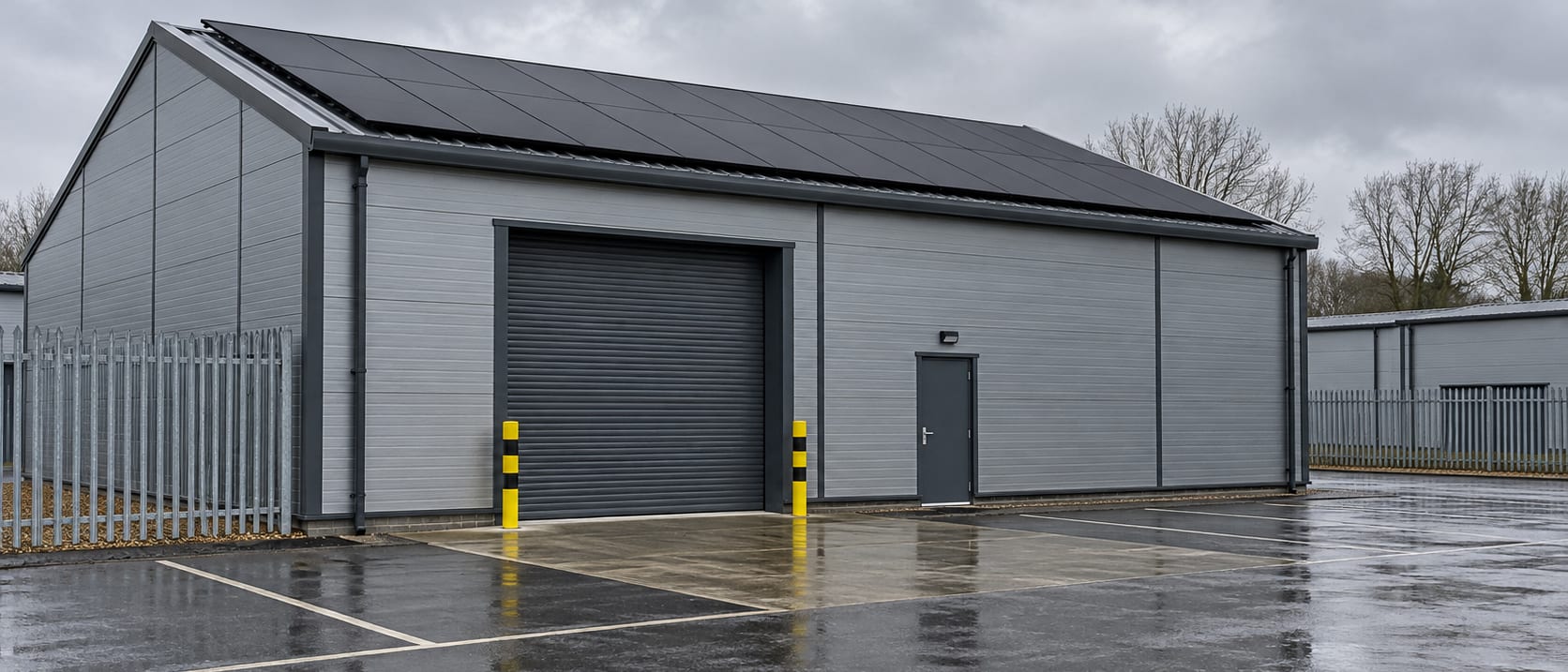
A commercial warehouse roof covered in rows of solar panels
For business

Take a fixed cost off the balance sheet.

Commercial arrays sized against a year of your half-hourly data, with the grid application, the export limitation and the handover pack handled by us.

Three ways to pay for it

The right route depends on whether you want the asset on your balance sheet or the saving in your P and L. We will quote more than one.

Lease or asset financeSpread the cost over a fixed term. The array is on site from day one and the repayment is set against the saving.Price on application
Power purchase agreementA funder pays for the system and you buy the units it produces at an agreed rate, usually below your import price. No capital outlay and no maintenance liability.Price on application

What we need to quote properly

Send these and you get a model. Send none of them and you get a guess, and we would rather not give you one.

Half-hourly data
A year of it, from your supplier

This is the single most useful thing you can send us. It shows when you actually use power, which decides how much of the generation you can consume on site rather than export. Any supplier will provide it for a half-hourly metered site; ask for the HH data for the MPAN.

Your import rate and standing charges
The current contract, not last year

The value of a self-consumed unit is whatever you are paying for an imported one. Without the current rate the model is guesswork.

Roof plans or a drone survey
Or we will measure it

Plans speed things up. Where there are none we survey, and for larger roofs that means a measured survey and a structural opinion rather than an estimate from aerial imagery.

Supply details
MPAN, phases and the main breaker rating

This sets what we can connect and whether the application is G98 or G99. It is also what the DNO will ask for first.

Roof age and any warranty
Including who holds it

Penetrating a roof under warranty can void it. On single-ply and standing-seam roofs there are non-penetrative systems that keep the warranty intact, and we need to know before the design rather than after.

Planned changes to the site
New plant, an EV fleet, a unit let out

An array sized for today is the wrong size for a site that is about to add a fleet of vans. Tell us the plan and we size for it, or we design in headroom and say what it costs.

The grid application, and what the network can say back

Commercial systems almost always need G99 approval from the Distribution Network Operator, which is Electricity North West or SP Energy Networks, depending on where you are, before any installation work starts. The application goes in with the design, and the lead time is measured in weeks, not days.

When the network says no, or says not that much

A constrained part of the network may offer a smaller export capacity than the array could produce, or offer a connection subject to reinforcement works at your cost. Neither is unusual and neither is fatal.

  • Export limitation holds the array back from exporting beyond an agreed figure while letting you consume everything on site. On a site that uses most of its own generation this costs very little.
  • Sizing to your own load rather than to the roof area often removes the problem entirely, and shortens the payback.
  • A battery changes the shape of the export profile and can make a constrained connection workable.

What we submit

The application, the single line diagram, the inverter compliance certificates and the protection settings. We deal with the DNO correspondence and we tell you the moment a condition appears that changes the design or the price.

The roofs we work on

Straightforward

  • Trapezoidal profiled steel with sound fixings.
  • Standing seam with non-penetrative clamps.
  • Flat single-ply with a ballasted system where the structure allows.
  • A south, east or west slope with clear access for a MEWP.

Needs a conversation first

  • Asbestos cement sheet, where the right answer is often ground mount or a re-roof.
  • Roofs with a live manufacturer warranty we would have to penetrate.
  • Structures already near their loading limit.
  • Roofs with less than ten years of life left.
  • Sites where access for plant means closing a yard that cannot close.

How a commercial project runs

Model it against your data

We take a year of half-hourly readings and your current import rate and model how much of the generation the site would actually use. That tells us the array size worth building rather than the one the roof would hold. You get the assumptions written down with the numbers.

Survey and structural opinion

An engineer goes on the roof, checks the sheet profile, the fixings and the condition, and confirms the access route for plant. Where the loading is close to the limit we get a structural opinion before the design is fixed, because that is cheaper than finding out at installation.

Design, G99 application and a fixed price

The layout, the string design, the inverter schedule and the single line diagram go together, and the grid application goes in with them. Once the DNO position is known the price is fixed, and it only moves if the scope moves or a connection condition changes the design.

Install around your operation

We programme the work around your hours rather than asking you to shut down. Deliveries, plant and roof access are agreed in advance with whoever runs the site, and the electrical tie-in is booked for a window you choose.

Commission, monitor and hand over the pack

We commission with the DNO protection settings in place, set the monitoring up so your own people can see generation and consumption, and hand over the certificates, the as-built drawings and the operating and maintenance information in one pack.

Common questions from business buyers

No. The zero rate applies to domestic installations only, so a commercial install is charged at the standard rate. We show the VAT separately on the quote so the capital figure and the recoverable element are both clear.

It depends on the roof area and on how quickly plant can get to the roof. We programme around your operating hours rather than assuming you can shut down, and we give you a week by week plan with the fixed price so you can see what happens on site and when.

Often yes, and the route depends on who holds the lease and who holds the roof. We will talk to the landlord as well as to you, and the funded route tends to suit a tenant because the agreement follows the electricity rather than the asset.

Yes, where there is land and a sensible cable route back to the supply. It sidesteps roof condition and roof warranties entirely, and access for maintenance is easier, so on a site with spare land it is often the better answer.

Asset finance and power purchase agreements are tied to the site rather than to you, so raise it before signing anything. If a move is possible inside the term we will say so and look at the capital route instead.

Send us a year of half-hourly data and we will model the array against it.