Solar panels, fitted and signed off properly.
We survey the roof, design the array around it, handle the DNO and MCS paperwork, and tell you plainly if the numbers do not work.
How a solar install actually goes
Desk estimate from your bill
Send a recent bill and your postcode. From the annual units and your roof on aerial imagery we come back with a system size, a generation figure and a first price. This is an estimate, and we say so.
Survey on the roof, not on the phone
An engineer measures the roof, checks the tile or slate type and the condition of the battens, looks at shading across the day, finds a cable route to the consumer unit, and checks whether the board has a spare way and an adequate main fuse.
Design and a fixed price
You get a layout showing panel positions, the string design, the inverter and the expected annual generation, plus a price that does not move unless you change the scope or we find asbestos or structural work behind the tiles.
Grid notification, then install
We submit the DNO application, handle G98 or G99 approval, book scaffolding and fit the system. Most domestic jobs are one to two days on site with the scaffold going up the day before.
Handover and the export tariff
We commission the system, show you the monitoring app, hand over the MCS certificate and the electrical certificate, and point you at the export tariffs worth applying for.
What the roof needs
Every one of these comes up at the survey, so here is what we are looking for before we get there.
- Orientation
- South is best, east and west still work
A south-facing roof gives the biggest annual total. An east and west split gives less in total but spreads it across the morning and evening, which suits a household that is out at midday. A north-facing slope is not worth panelling and we will say so.
- Pitch
- Most UK roofs are already close to ideal
Somewhere around thirty to forty degrees is the sweet spot in this country, and that is what the majority of pitched roofs here are built at. Shallower or steeper costs you a few percent, not the project.
- Shading
- One chimney can cost more than one panel
Shade on part of a string drags the whole string down unless the design allows for it. Where a chimney, dormer or neighbouring tree is in the way we either lay the array out around it or use optimisers on the affected panels, and we tell you which we are doing and why.
- Roof covering
- Concrete tile, slate, pantile or standing seam
Each needs a different mounting kit and a different amount of care getting back to watertight. Slate takes longer than concrete tile. Artificial slate and fragile older pantiles sometimes need replacement tiles on hand, which we price in rather than discovering on the day.
- Structure
- Rafters and battens have to carry the load
A standard array adds a modest distributed load that almost every sound roof takes without help. Where the timbers are undersized, sagging or already carrying a conversion, we say so before we quote rather than after we are up there.
- Consumer unit
- A spare way and an RCD that will hold
The array needs its own protected circuit. Older boards sometimes need a replacement, which is on the not-included list on the homepage because it is a separate job with a separate price.
Where solar stacks up, and where it does not
Worth doing
- Somebody at home during the day, or appliances that can be put on a timer.
- An unshaded roof slope facing anywhere from east through south to west.
- A roof that has life left in it, so the panels come off once in twenty five years and not in five.
- An electric car, a heat pump or a hot water cylinder, because the extra daytime load is what makes the sums work.
- A battery in the plan, now or later, if the house is empty from nine to five.
We will tell you not to bother
- A north-facing slope with no alternative elevation.
- Heavy shade from a building or mature trees across most of the day.
- A roof that needs stripping and recovering first. Do that job, then call us.
- A flat or near-flat roof with a covering near the end of its life, where the ballast and penetrations are a bigger risk than the saving.
- A tiny annual consumption, where the payback runs past the warranty on the inverter.
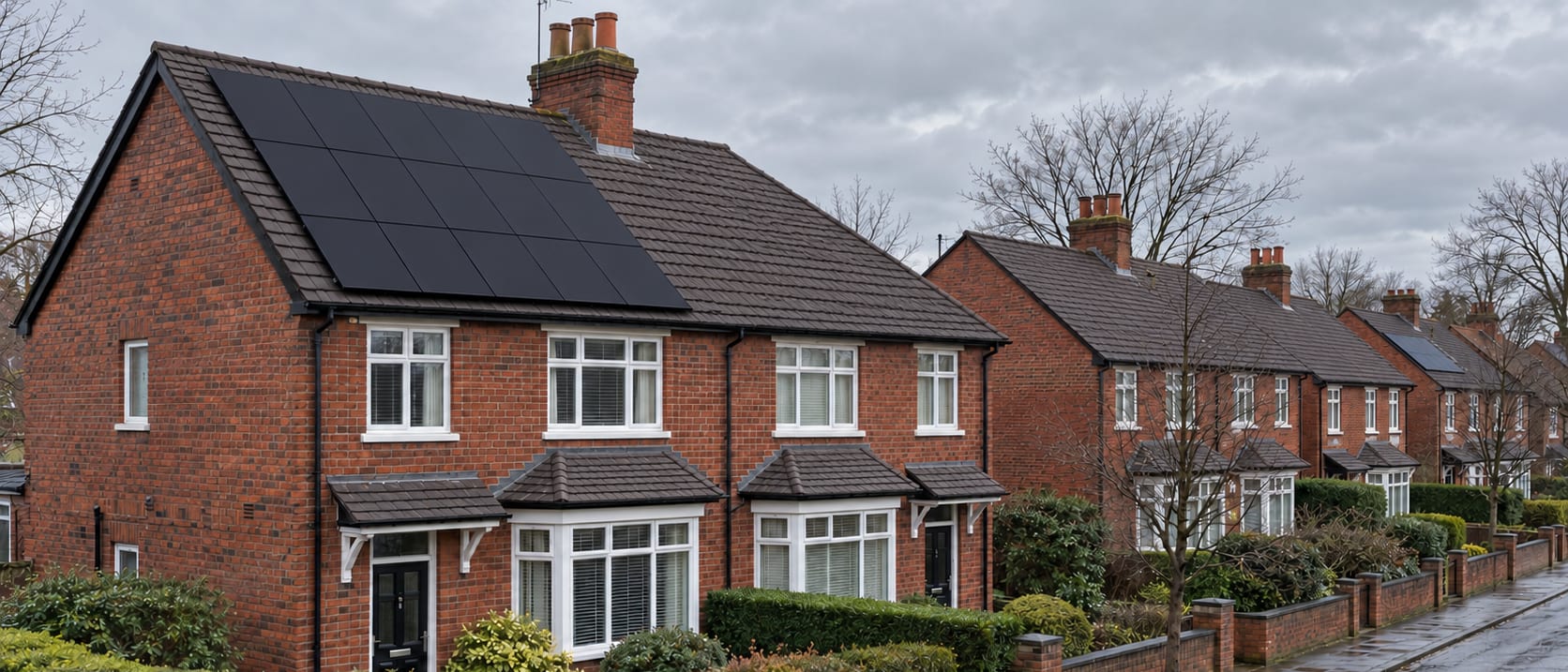
An all-black array on a typical North West semi. Photo placeholder until we have our own jobs to show.
The paperwork, in plain English
G98 and G99
Anything that can push power back into the grid has to be known to your Distribution Network Operator, which in the North West is Electricity North West or SP Energy Networks depending on your address. Smaller single-phase systems are notified under G98 after the install. Larger ones need G99 approval before any work starts, and that approval can take weeks, so we apply as soon as the design is signed off.
We submit both. You do not deal with the DNO.
MCS certification
An MCS certificate is the document that proves the install met the scheme standards. You need it to apply for an export tariff, and it is the thing a solicitor asks for when you sell the house. It is issued against the installed system, so keep it with the deeds.
The Smart Export Guarantee
Larger energy suppliers must offer a tariff that pays you for the units you export. Rates differ a lot between suppliers and they change, so the right move is to compare at handover rather than to assume your current supplier is competitive. You apply with your MCS certificate and a smart meter capable of half-hourly export readings.
Planning and building regulations
Roof-mounted domestic solar is usually permitted development as long as the panels do not project more than 200mm from the roof plane and the property is not listed or in a conservation area. The electrical work is notifiable under Part P and is covered by the certificate we issue. We check all of this at the survey, not after.
VAT
Domestic installations of solar panels and battery storage are zero-rated for VAT in Great Britain until March 2027. Our domestic prices are shown including VAT so there is nothing to add at the end.
Common questions about solar
Yes. The North West gets less sunshine than the south coast, and the gap is smaller than most people assume. Panels generate from daylight rather than from heat, so bright overcast days still produce, and cooler air actually helps panel efficiency. Orientation and shading on your particular roof matter far more than the region does.
Mounting hooks sit on the rafters and the tiles are cut or dressed around them, so removal means replacing a small number of tiles and making good. We photograph the roof as we go so you can see what is under the array.
Yes, tell them once the system is commissioned. Most insurers treat a certified solar install as a normal improvement and do not load the premium, but they do want it on the record. We give you the certificates you need to send them.
Panels are the long-lived part and carry a long performance warranty, typically guaranteeing a percentage of original output decades out. Inverters are the part that wears, and a replacement during the life of the array is normal rather than a fault. We tell you the specific warranty terms for the kit we quote.
Rain does most of it on a pitched roof in this climate. Flat or very shallow arrays collect dirt and need occasional washing. If a panel is shaded by a new tree or fouled by birds the monitoring usually shows it before you notice, which is one reason we set the app up with you at handover.