A battery is only worth it if the sums are.
We size storage against your actual half-hourly use, not against a brochure. Sometimes the answer is a smaller battery than you expected, and sometimes it is none.
Where the money actually comes from
A battery does not generate anything. It moves cheap or free units to the time of day when units are expensive, and there are only three ways that pays.
Storing your own generation
Solar produces most at midday and a typical household uses most at breakfast and in the evening. Without storage the surplus exports for a few pence. With storage it covers the evening at the rate you would otherwise have paid.
Charging on a cheap overnight rate
Time of use tariffs price the small hours far below the day rate. A battery filled overnight and discharged through the peak cuts the bill on its own, with or without panels on the roof.
Avoiding the peak charge
Some tariffs load the late afternoon and early evening specifically. Riding through that window on stored power is where the clearest saving sits, and it is also the one that depends most on your tariff staying available.
How we size it
Six things decide the specification. None of them is the number printed on the front of the battery.
- Usable capacity
- Not the same as the number on the box
Manufacturers quote total capacity and a separate depth of discharge. What matters to you is the usable figure, and whether the battery can be run to that figure every day without voiding the warranty. We quote usable.
- Your evening load
- Taken from half-hourly data, not a guess
With a smart meter your supplier can give you a year of half-hourly readings. That shows how many units you really pull between four and ten in the evening, which is the number that sets the capacity. Without it we work from annual units and your routine, and we say that the figure is coarser.
- Charge and discharge rate
- Power matters as much as capacity
A large battery that can only discharge slowly will not carry an oven, a kettle and a shower at once. We check the continuous output against the loads that actually overlap in your house.
- Cycles and warranty
- Throughput, not just years
A battery warranty is usually a combination of years, a total energy throughput and a retained capacity percentage. One cycle a day for a decade is a lot of throughput, so the throughput figure is the one to read.
- Where it goes
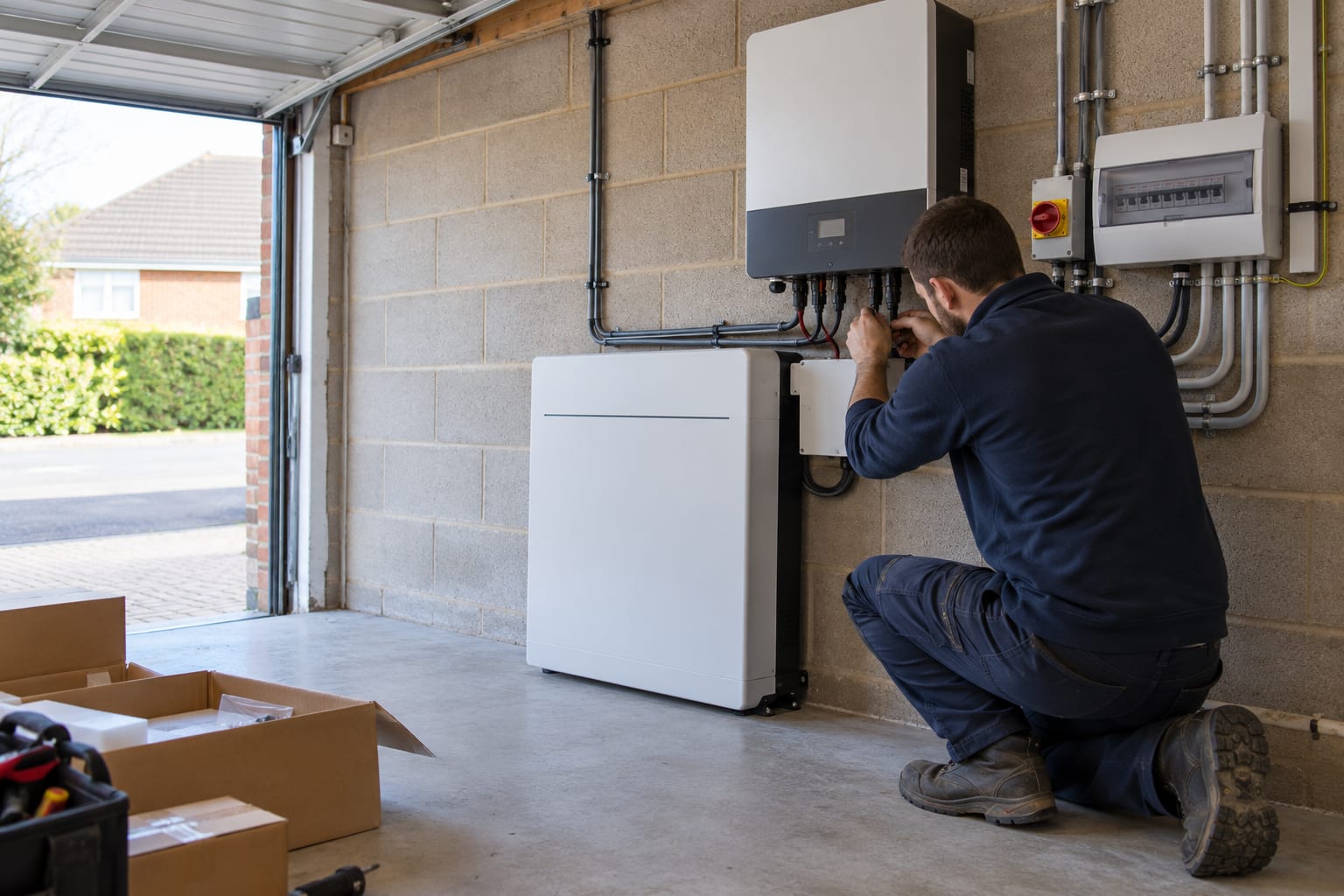
- Garage, utility or outbuilding, ideally
Batteries want a dry, ventilated, frost-free space with room to work around them and a sensible cable route to the board. We avoid habitable rooms and escape routes, and we check the mounting wall will carry the weight.
- Grid notification
- G98 or G99, the same as solar
Storage that can export is notifiable. We handle the application, and where the combined inverter capacity pushes past the G98 threshold we apply for G99 approval before any work starts.
Hybrid or AC coupled
Two ways to wire storage. Which one you want depends mostly on whether you already have panels.
Hybrid inverter, when solar and battery go in together
- One inverter handles the panels and the battery, so there is less kit on the wall and one app.
- Charging from the roof happens on the DC side, which avoids a conversion step and the small loss that comes with it.
- Usually the cheaper route when both parts are being installed at once.
- Commits you to that manufacturer for both halves of the system.
AC coupled, when panels are already there
- The battery brings its own inverter and sits alongside whatever is already fitted, so nothing working gets ripped out.
- Lets you pick the battery on its merits rather than on what matches an existing inverter.
- Two inverters means two points of failure and a small round-trip loss.
- The route we almost always use for retrofits, and the only one that makes sense for a battery with no solar at all.
Backup in a power cut
A standard grid-tied system shuts down in an outage. That is not a fault, it is a safety requirement: an inverter that kept pushing power into a dead network would put whoever is working on it at risk.
What backup actually requires
Running circuits through an outage needs a battery and inverter rated for it, plus a changeover arrangement and a separate backup distribution board so the protected circuits can be isolated from the rest of the house. It is extra kit, extra cable and extra cost, and it is much cheaper to design in at the start than to add afterwards.
- Decide which circuits matter. Usually a freezer, the boiler controls, the router and some lighting, rather than the whole house.
- Accept that an electric shower, an oven and a heat pump are generally outside what a domestic backup will carry.
- Tell us at the survey, before the design is fixed.
If backup is the main reason you are calling
Say so first. The specification changes, the price changes, and a battery chosen for bill savings is often the wrong one for keeping the lights on.
If a battery will not pay for itself on your tariff and your usage, we will tell you that and quote you solar on its own.
That is a worse sale for us and a better job for you.
Common questions about batteries
Yes, and on a time of use tariff it can pay on its own by charging overnight at the cheap rate and carrying the house through the expensive hours. It does nothing for your carbon footprint the way panels do, but the bill maths can still work.
Battery storage installed at a domestic property is zero-rated in Great Britain until March 2027, whether or not it goes in with solar. Our domestic prices are quoted including VAT.
A garage, utility room, plant cupboard or outbuilding, somewhere dry, ventilated and frost-free with a sensible cable route to the consumer unit. We avoid bedrooms, loft spaces that bake in summer and anything on an escape route.
Most home batteries are near silent, but the inverter has a fan and will be audible in a quiet room when it is working hard. That is a reason we prefer a garage or a utility to a hallway next to a bedroom.
Capacity fades gradually rather than failing outright, so the system keeps working with less usable storage. The warranty will state a retained capacity after a given throughput, and the modules are replaceable on most of the systems we fit. We tell you the specific terms for the kit we quote.