A charger is an electrical job, not a bracket on a wall.
Most of the work is in the supply: what the main fuse will carry, how the house is earthed, and where the cable can actually run. We check all three before we quote.
Where the charger goes
Position is a compromise between the cable run, where the car parks and where you want to stand in the rain.
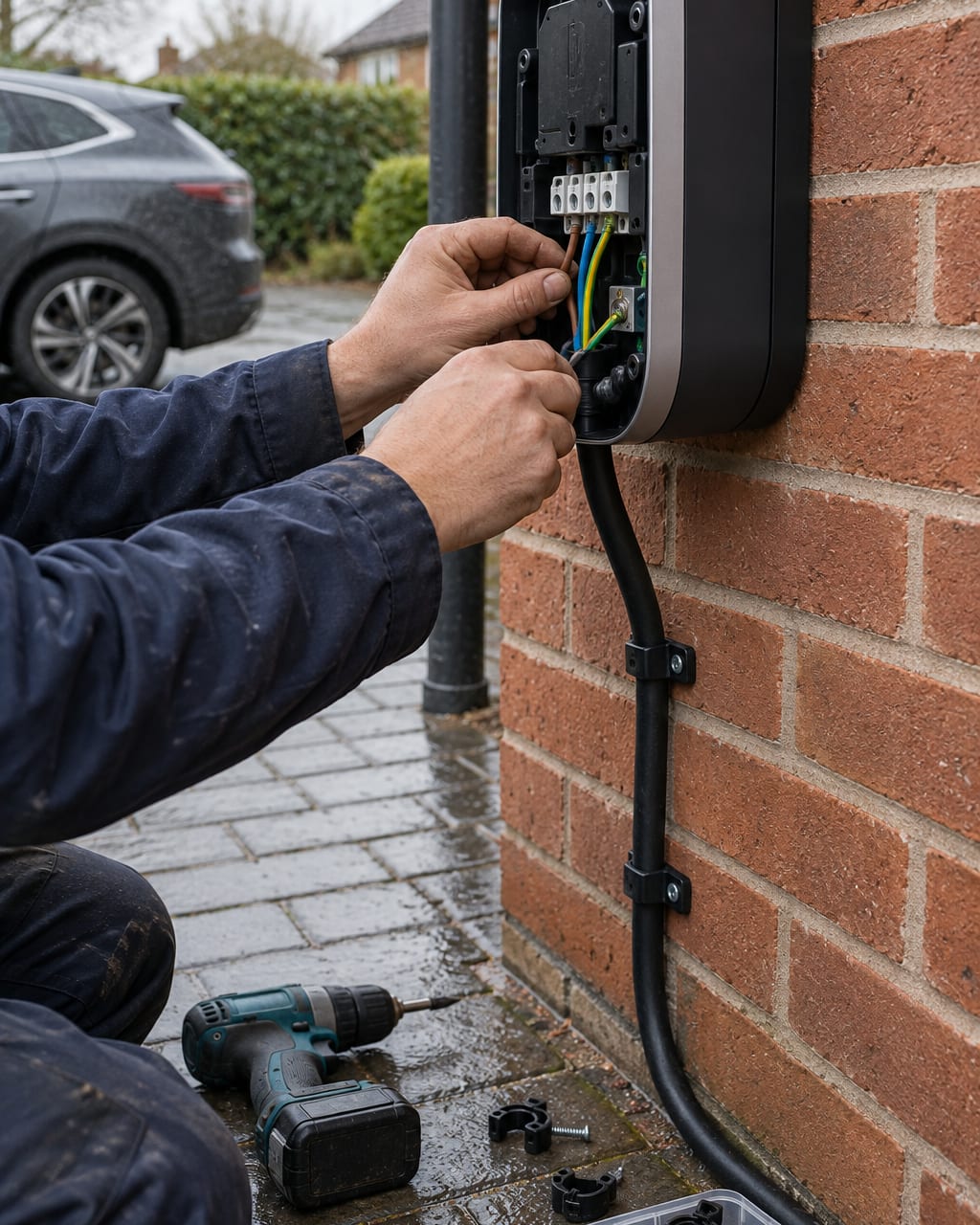
Terminating the supply into an untethered unit. The cable route back to the board is the part that sets the price.
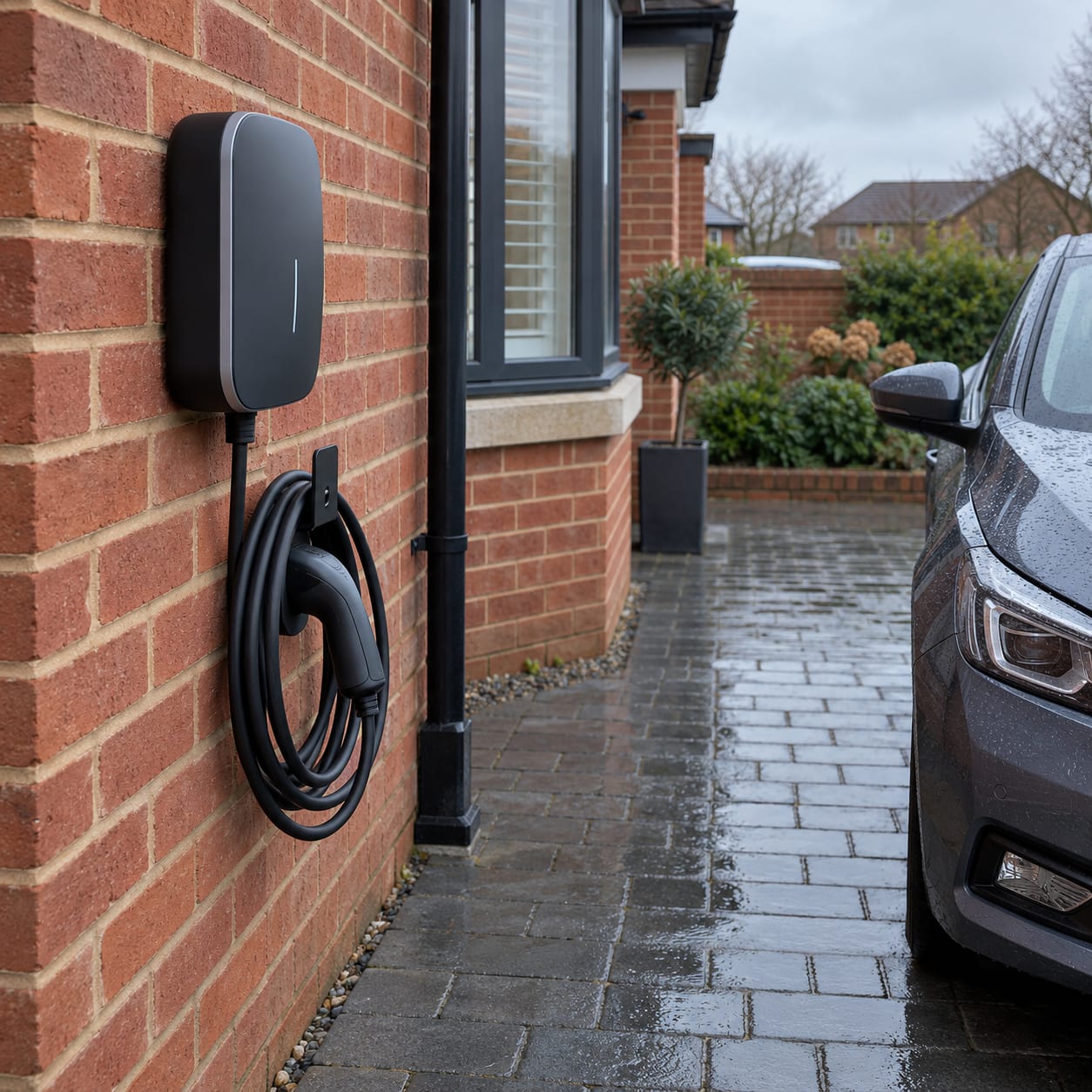
A finished install on a driveway wall, with the cable tidied rather than left hanging.
The bits people forget
Two quotes for the same charger differ because of these, not because of the box on the wall.
- Charge rate
- 7.4kW on a normal house, 22kW only with three phase
A single-phase domestic supply tops out around 7.4kW, which adds a useful amount of range overnight for almost every driver. 22kW units need a three-phase supply, and getting three phase installed is a DNO project with a DNO price, not an upgrade we can do on the day.
- Main fuse and existing load
- The whole house has to fit behind one fuse
A charger pulling 32A sits alongside the shower, the oven and the immersion. We work out the maximum demand properly, and where it does not fit we either fit load management that backs the charger off when the house is busy or ask the DNO about a larger fuse.
- Earthing arrangement
- Open PEN protection instead of an earth rod
Most houses here are PME, where the supply neutral doubles as the earth. Outdoors that creates a specific shock risk if the supply neutral fails. Modern chargers detect that condition and disconnect, which is why we no longer dig in an earth rod on most installs.
- Cable route
- The longest part of the job
From the consumer unit to the charger, through walls, around a garage, under a drive or clipped along a fascia. The route decides the cable size, the labour and most of the price difference between two quotes on the same house.
- Protection
- Its own way in the board, with the right RCD type
A charger needs a dedicated circuit with appropriate residual current protection. Some units include part of it internally, which changes what the board needs. We check what the specific model provides rather than assuming.
- Tethered or untethered
- A cable on the wall, or one in the boot
A tethered unit is more convenient and a bit untidier. An untethered socket is neater, works with any vehicle lead and means the cable lives in the car. Neither is better; it depends who is using it.
Solar matching
A charger with a metered feed from the incoming supply can follow the surplus, ramping up as the array produces and backing off when the kettle goes on, so nothing is drawn from the grid.
Tariff scheduling
Most smart chargers will take a cheap-rate window from your tariff and do the bulk of the charging inside it. That is usually the bigger saving, and it works with or without panels.
Doing both
Top up from the roof during the day, fill from the cheap overnight window, and keep the battery for the house rather than the car. We set the priorities up with you at handover instead of leaving you in the app.
Charging the car from your own roof
The cheapest unit you will ever put in the car is one your roof made ten minutes ago. Getting that to happen reliably needs the charger and the inverter to be talking to each other. See solar panels and battery storage for the rest of the system.
Rules, grants and paperwork
Smart charging is mandatory
Every domestic charge point sold in Great Britain has had to be smart since the 2021 regulations: it has to be able to schedule, to respond to signals and to come with a default off-peak charging window. Anything that cannot is old stock, and we do not fit it.
Grants
The government grant for houses with off-street parking has closed. The schemes still running are aimed at flats and rented property, and at landlords fitting chargers for tenants. If you are in a flat or you let the property, tell us and we will tell you honestly whether you qualify, because the rules change and the application has to be in before the work.
Notification and certification
The circuit is notifiable under Part P and we issue the electrical installation certificate for it. Where the charger can take part in load management or export we notify the DNO as well. You get the paperwork at handover, which matters if you ever claim against the installation.
VAT
A charge point on its own is charged at the standard rate of VAT, unlike solar and storage. If the charger goes in as part of a solar or battery install the treatment differs, and we show the VAT on the quote either way so the comparison is honest.
What a charger visit covers
Photos before we come out
Send a picture of the consumer unit, the meter and the incoming supply, plus a shot of where the car parks. Nine times out of ten that is enough to price the job properly without a visit.
Supply and earthing check on site
We confirm the earthing arrangement, read the main fuse rating, calculate maximum demand against the existing load and settle the cable route and the charger position with you.
Install and test
A dedicated circuit from the board, the charger mounted, everything tested and certified. Most domestic chargers are a half day unless the cable route is awkward.
Set up and hand over
We pair the charger with your app, set the off-peak window, set solar matching if you have an array, and leave you the certificate and the warranty details.
Common questions about chargers
A granny lead works, but it is slow and it was never designed to pull a continuous load through an old socket night after night. A dedicated charge point is faster, properly protected, and it is the only route that gives you scheduling and solar matching.
Running a cable across a public footway needs permission from the council, and most of them do not grant it. We will not promise an install we cannot legally do, so tell us the parking situation first and we will tell you plainly whether it is possible.
Yes. Type 2 is the standard connector on every car sold here, and an untethered unit takes whatever lead came with the vehicle. A tethered unit has the lead attached, which is more convenient but ties you to that connector.
That depends on the battery in the car rather than on the charger. The figure that matters is that a 7.4kW charge point adds a usable overnight charge for almost every driver, so the car is full each morning without you thinking about it.